Hello! These are some examples of the texts that I would use in an ESL classroom. Since I am hoping to teach ESL in a K-12 setting, I chose texts that I could use in every grade, but it really depends on the level of proficiency the student is at.

Summary
In this short video, students will watch a scene out of the Pixar movie The Incredibles. Within this scene, they will hear a conversation between the parents and children about one of the kids going to the principal's office. Within the conversation, there will be vocabulary words that are specific to the families dinner setting.
Analysis
Quantitative: Even though this scene is from a kids movie, this is a video that can be enjoyed by anyone who has seen the movie. I would use it for middle/ high school aged children because of the vocabulary that was picked.
Qualitative: This video is a great resource for conversation between multiple people, parents and children. Using a popular kids movie, this should be a relevant video that engages students!
Purpose
I would use this video to show students a conversation between more than two people. Most students have heard of, or seen The Incredibles, so this would be a cool way to start a lesson. I think this type of video could help prepare students for a lesson on fast-paced conversation, or social interactions, like family dinner.
Vocabulary
Yikes - expression of shock
Carnivore - meat eater
Dissect - cut up in order to study (used in science class)
Tack - Short for thumbtack, a sharp nail
Got away (with it) - (informal) to escape without blame
Booking - (informal) run really fast
Question or thinking activity
Come up with a couple sentences using the vocabulary from the video.

Summary
In this video, Jack Hartmann sings about the 6 questions you should ask yourself while reading. Who is the story about? What happened? When is the time or date? Where does the story take place? How did things go about? Why did it all come about?
Analysis
Quantitative: This is definitely geared towards children, but I think it can be used in all age groups when talking about reading and writing comprehension!
Qualitative: Very catchy song to learn the 6 questions that should be asked while reading and writing! This is something that we can use for any text we are reading in the class at any point!
Purpose
Reading and interpreting new text can be frustrating when you don’t know what to look for. This song can be used as a resource to remember what to look for while reading. This is also helpful when students have to write a story in class or as homework. Having it on YouTube also makes it accessible outside of school, in case a student wants to do some work after school hours.
Vocabulary or Phrases
Keep in mind - to be aware of something
What went down - what happened in the story
Work out - (in this context) how was the situation resolved
Question or thinking activity
At the end of a short story, I would ask my students the 6 questions of who, what, where, when, how and why.

Summary
A group of school kids who grew up in a village in Botswana, Africa, went to Makgadikgadi Pans National Park and saw some elephants. There’s a group called Elephants for Africa that work along people and elephants to make sure that they can coexist in the same environment. In some parts of Africa, Elephants and humans coexist and some of the people in those environments have a fear towards elephants. The text also talks about poaching and how that is a threat towards the elephants in the area. Conservationists are working on keeping up the elephant population and want to teach the people who live in the same area to not be afraid of them.
Analysis
Quantitative: The site says that this is geared towards 5th-6th graders, but I believe that this can also be used in High School.
Qualitative: Engaging with tons of pictures that make it a quick and interesting read.
Purpose
I would use this text to test reading comprehension. At the end of the article, there is actually a quiz that will test this! This article also has some key vocabulary words highlighted and when you click on the word, a pop up comes up and shows you the definition.

Not only is the article interactive, you can also play it outloud and read along to it! Also, there is an option to read the article in Spanish, so this could be used in a bilingual classroom, or used for a Spanish class as well!
Vocabulary
Rural - a location that is outside of the city
Conservation - to preserve and protect something
Poaching - illegal hunting
Trample - step onto, crush
Conflict - a disagreement
Question
What is the main goal of Elephants for Africa (EFA)? (question found in the quiz at the end of the article).

Summary
Recycling the Tappan Zee Bridge into an artificial reef! These reefs will be used to help protect the ocean and sea animals and give them a home. Since coral reefs are in trouble, building the artificial ones can be helpful because the coral can start to grow on them. The article goes on to talk about the different materials that can be used to build the artificial reefs.
Analysis
Quantitative: The website says that this is for 2nd graders, but I think it can be used for all levels of English language learners.
Qualitative: Engages the students with a lot of interesting and colorful pictures. The video on the bottom also gives the students a cool “behind the scenes” look on scuba and how the scientists are preserving the coral reefs.
Purpose
I would also use this text to test reading comprehension. This article also is interactive in the sense that you can click on highlighted vocabulary words to get the definition and another example and the article can also be read aloud so the students can read along to it. I chose this article and the article above because this is a website that can be accessed whenever and has a huge selection of texts that a student can pick from.
Vocabulary
Artificial - man-made, not natural
Tourist - someone who travels to a different place
Coastal - near an ocean
Crisis - a difficult or dangerous situation
Question
What can cause the destruction of the coral reefs? (some examples are in the video at the bottom of the article).

Summary
This infographic shows that there is not one correct way to speak English and that there are multiple words for the same thing depending on what part of the world you are in!
Analysis
Quantitative: Can be used in an age group!
Qualitative: Personally, I think this is really important for students to see. If a student came from a European country and learned some English in their home country, it’s possible that they learned some British English!
Purpose
Like I stated above, it’s possible that a student has learned some English and it was British English. For example, we used to house foreign exchange students from Spain and they learned British English, so they would call certain things certain words. They weren’t wrong when they would use that vocabulary, so we wouldn’t laugh, or discourage them from using those words. I think it’s important that the students can see the words that they might already know for certain things and learn the American English version.
Vocabulary
For this, I would show an image of something, like a soccer ball, and the students could tell me what they call it!
Question
What are some other items that may have different names depending on where you’re located?
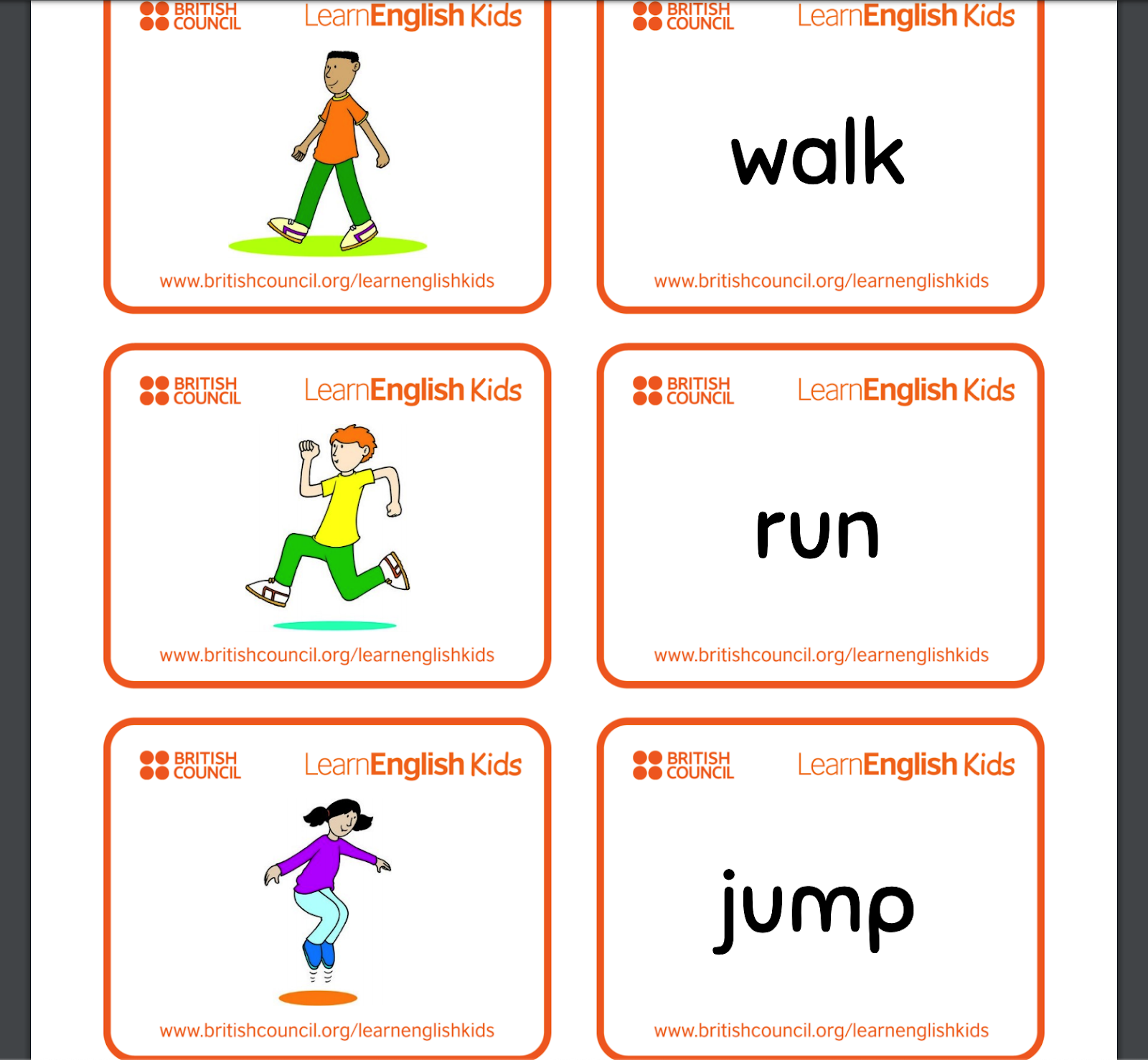
(https://learnenglishkids.britishcouncil.org/sites/kids/files/attachment/flashcards-actions-set-1.pdfthis image specifically)
Summary
This site has so many different options of flashcards that can be useful to students learning English. I chose the action ones specifically because they show an image and then have the word associating with them.
Analysis
Quantitative: Can be used for all age groups, but specifically for students beginning to learn vocabulary, specifically verbs with this set.
Qualitative: Can be used to test the students on how they are doing while learning English.
Purpose
Flashcards help learn and remember new words. Flashcards engage the students to use their brain and use word association. These flashcards can also be printed out, so they can be used anytime! They can help the students stay focused because they learn a different word with every card. Flashcards also help with active recall, which will help students during day to day tasks like conversation or even assessments.
Vocabulary
The vocabulary will be in the cards themselves!
Question/ activity
After using the flashcards, I would do an activity kind of like Simon Says and I would have the students stand up and recreate the verbs that I call out. If I say “run” they could run in place, or if I say “sit”, they could sit back down in their chair. This would show that they have learned the verbs.
Hi Maria,
ReplyDeleteI am from Group 2. I am checking out your blog because of the similarity of our profession. I teach Chinese language.
The 5 WH- questions have been around since I was in high school in Taiwan. They are key questions to ask in reading. I learned English in Taiwan. It seems to me American pedagogy focuses on creative methods and practical information. My learning experience was not as fun as your class.
Students learn English for various purposes but the most important one is to communicate and for education. Do your students need language support for their other subjects? If they do, how will you incorporate their needs in your instruction and curriculum design?
when you teach vocabulary, do you explain language use such as formal v.s informal, constrains in language use, and cultural background of idiomatic expression? In my experience as a former ESL high schooler in Taiwan, these information is very useful and important.
Chiung-Yueh
Maria,
ReplyDeleteI appreciate that you incorporated a lot of visuals in your text set. I think that they are to the point and would be a great resource. I also noticed that your inclusion of vocabulary throughout the text set was well thought out and presented. Nice job!
I think my favorite thing about this is your comparison of British and American English! I think it is important to show ESL Learners that there are always differences in how people speak English, plus it informs those about the differences in Americanized English specifically. I think your sources are innovative and fun, very engaging for students!
ReplyDelete-Sarah Toomey